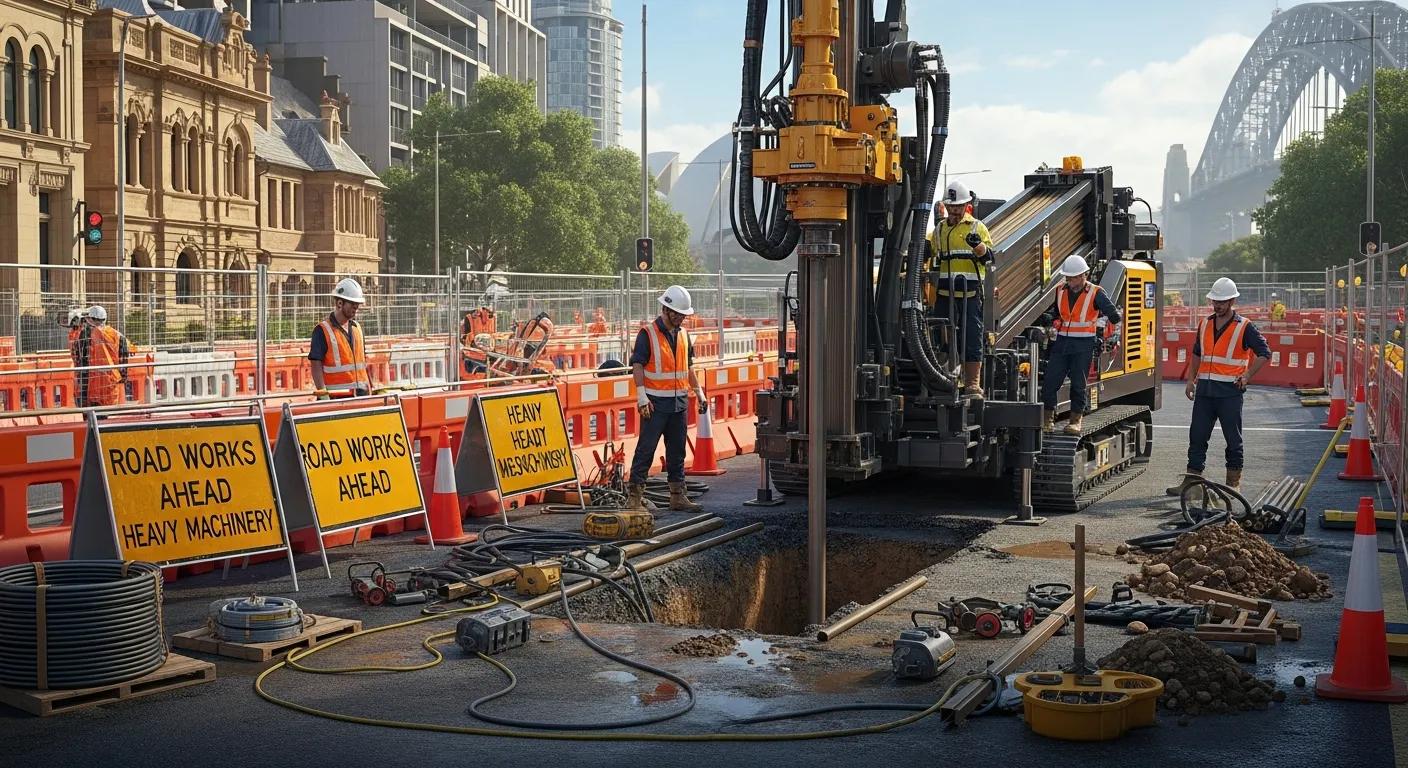
If you’re looking into under-road boring Sydney contractors, chances are you’ve hit the point where “just dig a trench” isn’t practical. Maybe you need to run a new service connection across a roadway, driveway, or access lane. Maybe the site is too busy, the surface needs to stay intact, or the reinstatement risk is simply not worth it. Under-road boring is designed for exactly that: creating an underground path for pipes or conduits without ripping up the surface end-to-end, which can be a game-changer for live sites and tight urban environments. Clearwater Plumbing & Civil provides under-road boring and broader plumbing + civil works across New South Wales, with hubs in Sydney and Port Macquarie.
When you need services installed, but you can’t afford to tear up the street.
On paper, open-cut trenching can look straightforward: excavate, install, backfill, and reinstate. In the real world—especially in Sydney—that approach can trigger a long chain of consequences.
Roads and driveways are rarely “just pavement.” They’re traffic routes, pedestrian paths, customer entry points, emergency access lines, loading zones, and sometimes the only way into a site. Cutting them open can create disruption that ripples through tenants, neighbours, site schedules, and approvals. Even when reinstatement is done carefully, surface repairs can be visible and may require ongoing monitoring—particularly in high-use areas.
Under road boring exists to reduce that surface-level disruption. It helps keep access open, limits excavation footprint, and can simplify the site experience while still achieving the goal: getting new services from Point A to Point B.
Under-road boring, explained in plain English.
Under-road boring is a trenchless installation method that uses directional drilling to create a subsurface pathway under roads, driveways, and other obstacles so that new pipes or cables can be installed without open trenches across the surface.
Think of it like threading a needle underground. Instead of cutting the road open and rebuilding it, the team creates a controlled underground bore from a launch point to a receiving point. Once that bore is established, conduits or pipes can be pulled through, and connections can be made at each end.
Clearwater’s own service pages describe road boring as a way to install pipes and cables under surfaces while avoiding disruptive open-cut excavation—particularly relevant for Sydney’s built-up infrastructure environment.
Why boring can be the better option than open-cut (and when it matters most)
Under-road boring is often chosen because it can reduce visible disturbance and keep critical areas functional. In practical terms, that can mean fewer interruptions to traffic flow, fewer complications around pedestrian movement, and less time spent dealing with surface restoration over a long corridor.
It can also reduce the “blast radius” of a job. With open-cut, a bigger area is impacted: excavation length, spoil handling, multiple reinstatement zones, and more barriers and controls. With trenchless boring, the work is more concentrated around the entry and exit points, which can be easier to manage on occupied sites.
Clearwater notes that trenchless methods preserve the road surface and nearby structures and can reduce downtime for infrastructure projects.
That said, it’s not about saying trenchless is always the answer. It’s about matching the method to the site reality. Where access, surface protection, and reduced disruption are priorities, boring is often worth considering early rather than as a last resort.
Planning and service locating: where good boring jobs are won or lost
The success of an under-roadmatter boring job is heavily influenced by planning—before anything starts moving. On a busy Sydney site, that planning isn’t bureaucratic busywork; it’s how you avoid clashes, rework, and unexpected disruption.
A well-planned approach typically includes:
- confirming what service is being installed (and the pathway it needs),
- identifying known and likely underground services,
- selecting appropriate entry/exit locations,
- and coordinating site access and controls so the work can proceed safely and smoothly.
Clearwater’s content highlights bore-planning and guidance to maintain alignment and support efficient installations without open trenches.
It’s also worth remembering that “the road” isn’t the only thing you’re boring under. In Sydney, you may be dealing with layers of previous works, legacy assets, and complex service corridors. That’s why careful planning and service awareness matters so much—because underground surprises are where time and cost blow out.
What a typical under-road boring job looks like on a Sydney site
Every site is different, but the general project flow tends to follow a similar rhythm—especially when the goal is minimal disruption.
It usually begins with a site assessment: confirming the bore length and alignment, identifying constraints, and working out where the least disruptive entry and exit points can be positioned. From there, the team plans the bore path, coordinates the site controls required (access, safety, stakeholder updates), and prepares the equipment.
Once the bore is completed, the conduit or pipe is installed through the created pathway. The final steps typically focus on connection, checking the installation is fit-for-purpose, and tidying up so surfaces and access routes are left in good order.
Clearwater describes under-road boring as a trenchless process for installing underground services beneath roads and tight spaces without disturbing surrounding surfaces, which reflects this typical “entry/exit point” style workflow.
Risk control around existing services and surface protection
Decision-makers often like under-road boring because it’s “less disruptive,” but the real value is deeper than that: controlled risk. When done properly, trenchless work is a deliberate way to reduce the chance of widespread surface damage and avoid turning a service install into a full reinstatement project.
That’s especially important in places where the surface carries consequences:
- roads with heavy traffic,
- driveways that must remain usable,
- access lanes for deliveries,
- and public-facing pedestrian areas where safety and appearance matter.
Under-road boring is commonly used for installing services such as water lines, sewer connections, electrical conduits, and communications pathways in built-up areas—exactly the kind of work where keeping the surface intact is a meaningful advantage.
In Sydney projects, risk also includes programme risk. When multiple trades are sequencing works tightly, the last thing you want is a road reinstatement delay that holds up other milestones. Trenchless methods can help reduce those dependencies, provided the job is planned carefully and the site constraints are understood.
When open-cut may still be the right call
A trustworthy conversation about trenchless boring includes the moments when it may not be the best fit.
Open-cut trenching can still be appropriate when the service corridor is short and clear, surface reinstatement is straightforward, or when ground and site conditions make boring impractical. Sometimes the limiting factor is space—if there isn’t a workable area for entry and exit points, or if the service corridor is so congested that alignment becomes too constrained.
There are also times when access to the existing asset requires excavation anyway, making a trench unavoidable for part of the scope. In those cases, the best outcome can be a hybrid approach: trench where necessary, bore where it meaningfully reduces disruption.
The point isn’t to force one method. It’s to choose the method that best protects the project—functionally, operationally, and practically.
FAQs about under-road boring in Sydney
What is under road boring used for?
Under-road boring is commonly used to install pipes and conduits beneath roads, driveways, and other obstacles without open-cut excavation across the surface. It’s often considered for utility connections like water, drainage, and communications, where keeping access and surfaces intact matters.
Is under-road boring the same as horizontal directional drilling?
It’s closely related. Under road boring typically uses directional drilling principles to create a controlled underground pathway, then installs the service through that pathway.
Why do projects choose boring instead of trenching?
Projects often choose boring to reduce surface disruption—especially where traffic flow, pedestrian access, or reinstatement risk is a major concern. It can also help keep a site functional while services are installed beneath an obstacle.
What’s the most important factor for a smooth boring job?
Planning. Confirming the service route, understanding site constraints, and being aware of existing underground services are the foundations of a smooth installation. Clearwater specifically references bore planning and guidance to maintain alignment and efficiency.
Can under-road boring reduce traffic disruption in Sydney?
Often, yes—because the work can be concentrated around entry and exit points rather than opening a long trench across the road surface. The exact disruption profile depends on the site layout and the controls required.
When might trenching still be necessary?
Trenching may be necessary when access is limited, the corridor is too congested, or when the asset you need to connect to requires excavation, regardless. In some cases, a mixed approach is the most practical path.
Keep your project moving without tearing up the surface.
When you need a new service connection but can’t afford the disruption of open-cut excavation, under-road boring can be a smarter, calmer pathway—especially on busy Sydney sites where access, safety, and reinstatement all carry real consequences. Clearwater Plumbing & Civil provides under-road boring and broader plumbing + civil works across New South Wales, with hubs in Sydney and Port Macquarie.
If you’d like to discuss a Sydney road crossing, driveway crossing, or trenchless installation requirement, reach out.
Call: 0410 997 080 Email: chris@clearwaterpc.com.au